
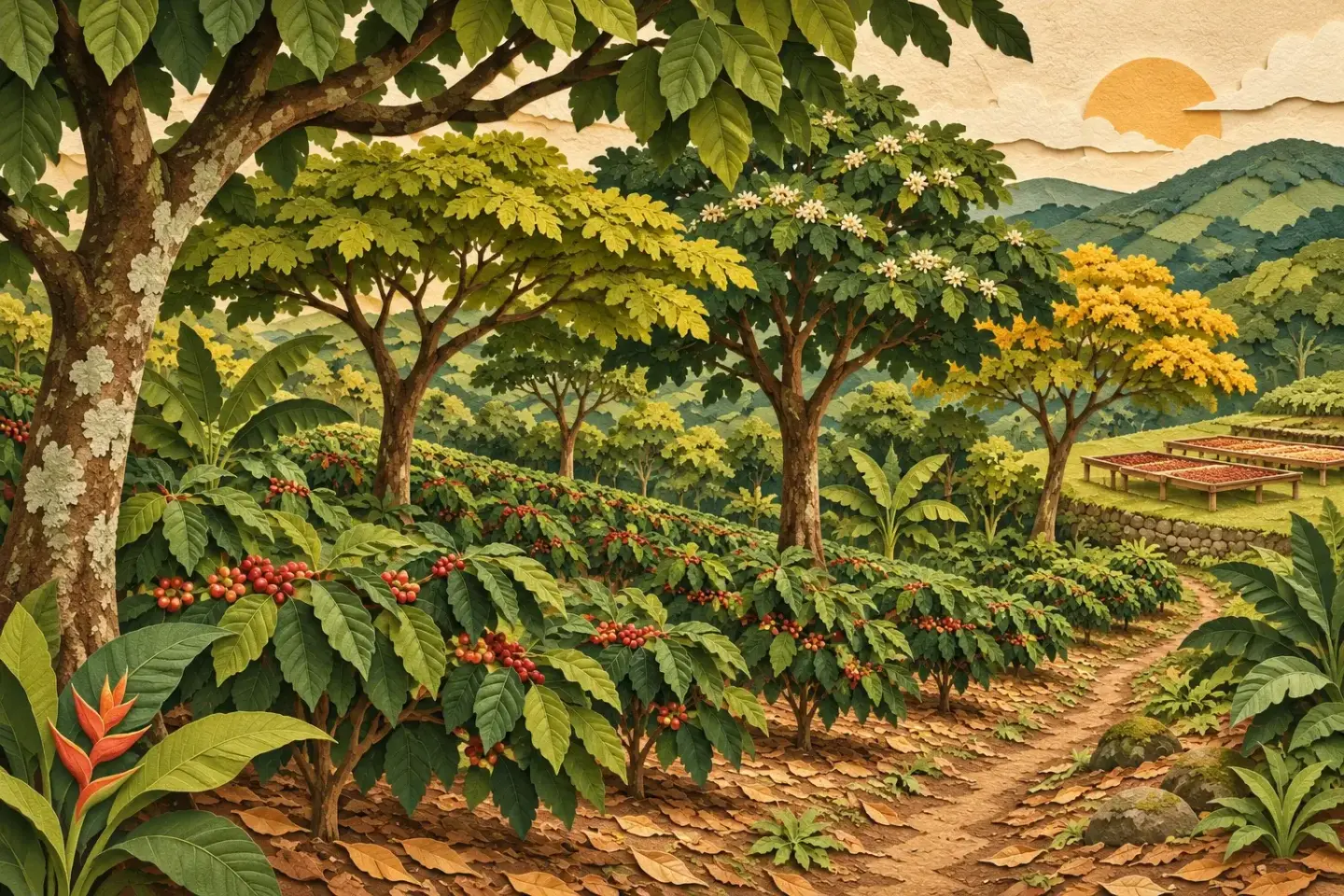
A photograph of coffee beneath a tall canopy can communicate a whole idea of sustainability in one glance. A farmer’s decision is more detailed. Which trees, in which places, with what management and what effect on the household’s work? Those questions matter more than whether a label says “shade-grown.”
This is a framework for discussing options with a qualified local adviser. It does not prescribe a tree species, planting distance or canopy percentage. Those choices depend on the site, coffee variety, management and the needs of the people farming it.
Decide what the trees are meant to do
Possible aims include moderating conditions around coffee, providing other products, protecting the soil or diversifying the farm landscape. Write down the primary aim and any secondary ones. Otherwise, a planting decision can be judged against a moving target: success for one purpose can be mistaken for failure at another.
The Coffee Shade Catalog is designed to help farmers and technical-assistance teams consider tree species found in coffee landscapes. Its own introduction acknowledges economic trade-offs as well as environmental benefits. Treat a catalog entry as a route into a locally informed discussion, not a universal prescription. Read the catalog’s scope.
Avoid one-number rules
A 2021 study of coffee systems in Costa Rica and Guatemala examined shade alongside agronomic investment. It found that productivity and shade could be compatible under some conditions and that high shade could limit the response to additional inputs. The important editorial lesson is conditionality: results from a study population do not establish the right canopy level for every farm. Read the original research.
When someone offers a single target, ask what it was measured against. Was the objective coffee yield, net income, a particular ecological indicator or resilience to a specified problem? A number without its objective and context is difficult to use responsibly.
Put labour on the page
Tree management takes work. Before introducing a new arrangement, discuss who will establish and maintain it, what equipment is available and when the work falls during the season. An option can look attractive in a diagram while arriving at the household’s busiest period.
Other tree products also need a route to use or sale. A fruit, timber or fuelwood possibility is not automatically an income stream. Consider access, harvesting, transport and the household’s preferences. Where a local permission or tenure issue applies, clarify it before changing the plot.
Keep the coffee itself in view
Coffee variety is part of the conversation. World Coffee Research provides a varieties catalog intended to support informed planting and renovation choices, with information relevant to performance and suitability. A variety name is not a guarantee of results; planting material and local conditions still require attention. World Coffee Research’s catalog.
For an existing plot, record what is already there before proposing a redesign. Note the coffee and trees, visible differences across the slope, the work currently required and the problem the farmer wants to solve. Ask which observations are firm and which are explanations that still need checking.
Make a comparison someone can revisit
With local technical advice, define a manageable observation plan. Record the date, area, management action and the outcome of interest. Keep weather and other changes in the notes so that a later result is not casually attributed to shade alone. One good season does not settle every long-term question.
Include the farmer’s own assessment of workability. A practice that is difficult to maintain without repeated outside support needs that limitation recorded. A realistic plan can combine environmental aims with labour, cash flow and the household’s use of the land.
The strongest shade discussion is therefore neither a promise that more trees always solve the problem nor a dismissal of agroforestry. It is a specific discussion about a plot, a purpose and evidence that can be checked over time.