
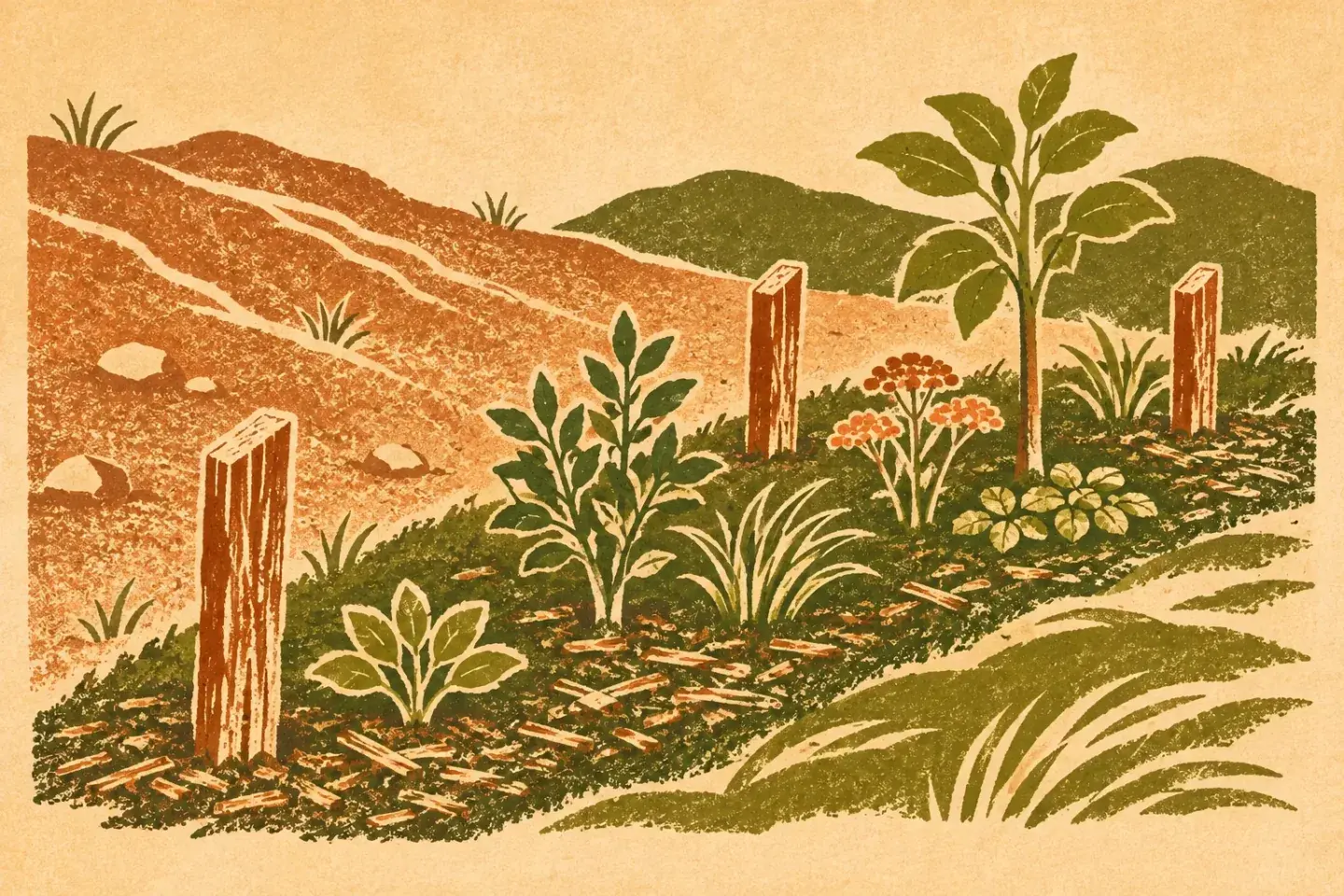
What does a hectare count establish about restoration? A target, an area with work under way and an area with a documented ecological outcome are different records.
FAO’s 29 October 2026 account of a UN restoration report describes documented areas under restoration. It also explains that regional totals reflect scale and reporting capacity rather than a ranking of performance, and notes limits in aquatic reporting. This note reads the announcement, not the full assessment or its underlying datasets.
Find the status attached to the area
For a hypothetical cooperative project note, label the area according to what the available record supports. A proposed boundary is not evidence that work began. A record of an activity is not, by itself, proof that the intended ecosystem condition has been achieved. A change in the reporting definition or mapped coverage also needs to remain visible when comparing successive totals.
Ask the project owner how the reported status is defined, which actions it covers and on what date it was recorded. Do not replace “under restoration” with “fully restored” for the sake of a shorter headline.
| Area statement | Evidence question |
|---|---|
| Target area | Which boundary and intended work does the plan identify? |
| Work recorded | Which action, place, period and status are documented? |
| Outcome claimed | Which indicator and observation support the stated result? |
Keep the boundary and date together
Retain the map or area reference used for the count. If two activity records cover the same ground, identify how overlap is handled before adding their areas. Repeated work on one parcel should not silently become additional distinct hectares.
For invented arithmetic, a plan identifies a 100-hectare boundary, with work recorded on 60 hectares inside it. Adding the two figures would not establish 160 distinct hectares. Keep the 100-hectare target and the 60-hectare work record with their different statuses; neither number alone demonstrates ecological recovery. This example concerns a fictional register, not the UN report’s data.
Similarly, a cumulative project figure and an annual activity figure need their periods explained. The same unit does not make them directly comparable.
Give the outcome its own observation
Choose the indicator appropriate to the particular claim and identify its source. A planting record, an observation of establishment and evidence about ecological recovery answer different questions. This article does not propose a universal restoration test or decide which indicator a local ecosystem requires.
Record what remains unavailable. Missing reporting does not prove that no restoration took place, just as a reported area does not establish every intended benefit.
The useful progress note carries its definition, boundary, status and date with the number. It can recognise work in progress while leaving the strength and durability of the outcome open to the evidence that actually measures it.